


« Qu’as-tu fait à l’école aujourd’hui ? » « Rien. » Quel parent n’a pas entendu cette réponse laconique de son enfant, qui en dit moins sur sa journée que sur sa difficulté à la raconter ?
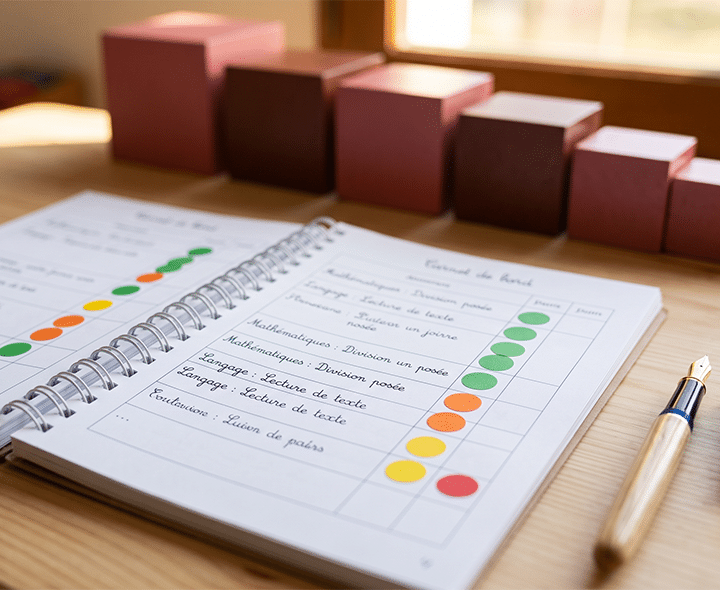
This year, six schools of the Cube Education network have implemented three documents designed to unravel this mystery: a logbook to track learning progress day by day, a report that summarizes it, and a sheet to prepare for the meeting with the educator. These three documents make visible work that classes have always carried out, and give parents a real role in monitoring their child’s progress, from kindergarten to elementary school. In our schools, we will continue to develop and evolve these tools to enable families to better understand, track, and support their child’s journey.
The most eventful “nothing” of the day
In the evening, in the car or on the sidewalk, the question returns, and the answer with it: “Nothing.” Behind this “nothing,” there was nevertheless a read-aloud, a division problem solved for the first time, a dispute settled in circle time, and three English words learned through song. A six- or nine-year-old child lives their day and willingly leaves it to others to provide the report.
The educational charter of the network makes two commitments in this regard: to precisely monitor what each child has acquired and what they still need to achieve, and to regularly inform their family. Because a child who progresses without their parents seeing it can lead to a family’s doubt. Hence, three documents, each with its role: the logbook for detail, the report for the essentials, and the meeting sheet for dialogue.
The logbook, progressive tracking of learning
The logbook tracks learning objective by objective. The educator fills it in progressively, in step with the work done in class, without waiting until the end of the period. This logbook is then given to families at the end of each semester, allowing them to discover what their child has acquired and the progress made over the whole period.
For a nine-year-old pupil, you might read, for example: “Read a one-page text fluently, at 90 to 100 words per minute”, or “Check whether a result is plausible by estimating an order of magnitude”. Each objective receives a coloured dot: acquired, in progress, discovering, or not acquired when support is needed.
In preschool, the logbook covers eight domains, from autonomy and practical life to the arts, including group life, French, English, and mathematics. In elementary, it focuses on fundamentals: French, mathematics, and English. Bilingual throughout, the logbook presents French at the top and English below; only the English section is read first… in English.
The report card, a snapshot of the journey
At the end of the first semester, or first trimester in schools that operate on that rhythm, comes the report card. The latter was designed to offer, in a few minutes, an overview. More condensed than the logbook, it groups several objectives under a single skill.
The educator adds what no grid can measure. A web depicts the child’s qualities: their autonomy, curiosity, perseverance, and others depending on age. The child’s portrait, in three to five lines, describes their attitude, progress, and strengths. The growth focus sets one or two concrete objectives, always phrased positively. These are the two paragraphs parents read first, and they are what make each report card a unique document.
Important element: the report card evaluates without grading or ranking. Its scale describes a moment in the journey: a skill “in discovery” in January simply announces the next step of the path. This is the signature of a pedagogy that watches each child advance at their own pace and compares their progress to their own starting point, rather than to their neighbor’s.
The meeting, three parts and three authors
Each semester, parents and educator meet for an individual conference. A form prepares it, in three parts written by three authors. Before the meeting, the educator fills in the first: the child’s well-being, their engagement in work, their relationship with the group, their level, and several qualities dear to Montessori pedagogy, such as “accepts error as part of learning” or “can explain what they are learning.”
Parents fill in the second: what they observe at home, and up to three questions they want to address during the conference. The appointment thus starts from what matters to the family: a concern about reading, a child who says they’re tired, a new passion for volcanoes. The educator knows them in advance and arrives with answers, examples, and even work completed in class. The third part is written together, during the meeting: each person’s commitments, and what will be observed before next time. Parents validate it with a “Read and approved.” At the next appointment, we begin by rereading these commitments. This is how school and family advance as partners.
A file that grows with the child
Logbooks, report cards, and meeting forms will join, period after period, a file that will follow each child throughout their schooling in the network. Enough to flip through the path traveled since the very first dots, and measure at a glance the distance between preschool and entry to middle school.
Some children will no doubt continue to answer “Nothing” when evening comes, but their parents will now know where to read the rest.