


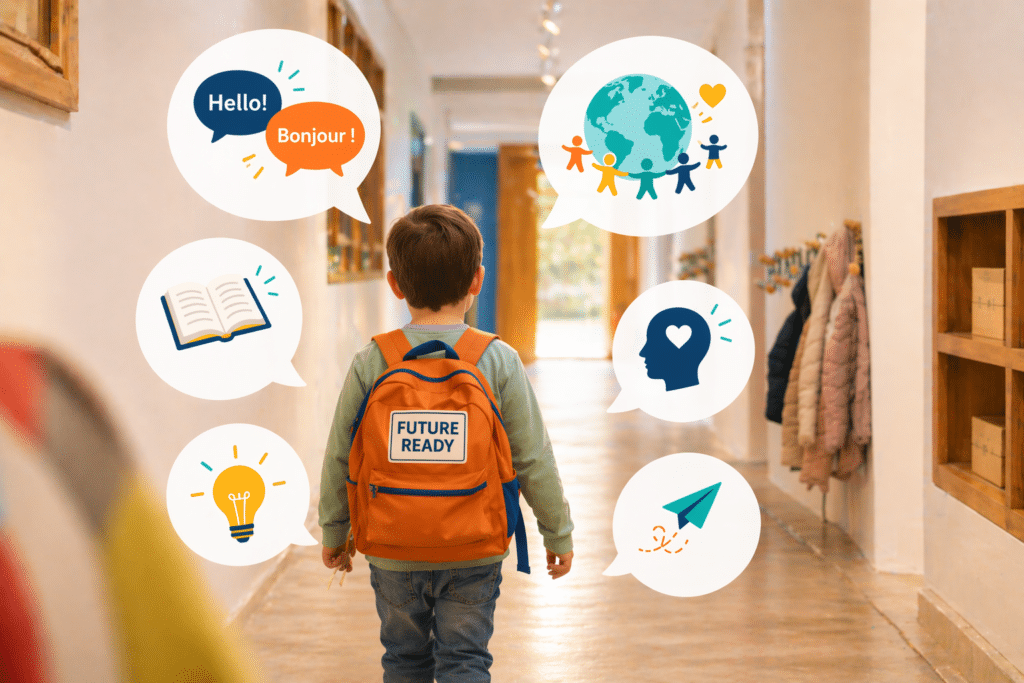
Long seen as a risky gamble, bilingualism in children is now widely studied. Research into neuroscience and child development is reassuring: far from hindering learning, it can, on the contrary, reinforce it over the long term.
In an increasingly interconnected world, learning English from an early age means giving your child the keys to understanding, communicating and growing with confidence.
A more agile brain: memory, attention and learning
Learning two languages means constantly training your brain. Andrea Mechelli’s work (2004) shows an increase in gray matter in areas linked to language and cognitive control. Ellen Bialystok shows that bilingual children develop better executive functions: memory, attention and the ability to filter out distractions.
In concrete terms, a bilingual child :
- retains complex instructions more easily
- stays focused even in noisy environments
- move from one task to another with greater fluidity
- solves problems more flexibly
A study by Albert Costa (2008) shows that they outperform monolinguals in cognitive conflict resolution tasks. Bilingualism also acts as a training ground for listening: children develop a heightened sensitivity to sounds and intonations, facilitating future learning of other languages. Research (Kovács & Mehler, 2009) also shows a better ability to filter out distractions and maintain attention.
The result is genuine mental agility, essential for learning, understanding and adapting.
Memory, academic success and adaptability
Early bilingualism strengthens working memory, essential for reading, comprehension and problem-solving. A study by the University of York (Bialystok & Barac, 2012) shows that bilingual children often achieve better academic results, particularly in reading and mathematics.
Why? Because they’re constantly juggling two language systems, creating more connections between words, concepts and ideas.
They also develop :
- greater cognitive flexibility
- a greater ability to adapt to new situations
- ease of learning other languages
In other words, a bilingual education prepares children to learn… for life.
Opening up to others: communication, empathy and trust
Being bilingual also means learning at an early age that the world can be seen in different ways. Children develop a better understanding of others, adjust their communication to different contexts and gain in confidence. In one famous experiment, bilingual children showed a greater ability to put themselves in an adult’s shoes by correctly interpreting what they saw – evidence of a more developed empathy .
This openness promotes :
- more refined communication
- greater social comfort
- greater self-confidence
In this way, they become true citizens of the world, able to evolve serenely in multicultural environments.
Learning two languages in practice
Maria Montessori emphasized the existence of a “sensitive language period” during which the child naturally acquires the sounds, structures and nuances of several languages.
There are in fact two forms of bilingualism:
- simultaneous bilingualism: two languages from birth
- sequential bilingualism: a second language introduced after 3 years
In this second case, the child relies on his mother tongue, may go through a phase of silent observation and temporarily mix languages. This is perfectly normal.
Good news: it’ s never too late to become bilingual. Even after the age of 5, the brain remains highly adaptable. But the earlier the exposure, the more natural, intuitive and lasting the learning.
Deconstructing preconceived ideas
“Bilingual children talk later”
The vocabulary is divided between the two languages, but broadly equivalent.
“They confuse languages”
Shuffling is a normal step, a sign of cognitive agility.
“Learning English early is useless”.
On the contrary, the earlier the exposure, the longer the benefits.
A natural immersion in everyday life
At Cube Education schools, language is learned because it is experienced on a daily basis. Thanks to regular, structured and caring immersion, children naturally associate language with positive experiences. Learning becomes fluid, progressive… and long-lasting.
From kindergarten onwards, English becomes a natural part of routines: morning greetings, discussion circles, Montessori activities, meals, songs and stories. The child hears, understands and then uses the language in concrete situations, without even having the impression of “learning”.
In elementary school, this immersion is gradually reinforced: certain activities are carried out in English with native teachers, and pupils take part in projects, give presentations or produce written work in both languages. This approach helps develop both confidence in speaking and structure in writing.
The key is regularity and repetition: it’s by using the language in a variety of contexts that the child anchors it for the long term.
At several Cube Education schools, students can also prepare for and take the Cambridge A2 Flyers (formerly Cambridge English Flyers), the final level in the Young Learners series.
This test validates a mastery of everyday English, both written and spoken, corresponding to level A2, a level generally expected much later in one’s school career.
Bilingualism at Cube Eduction
Growing up bilingual, building tomorrow’s world
Bilingualism is more than just speaking two languages. It develops a way of thinking, listening and understanding others.
Choosing a bilingual education means offering your child much more than an academic advantage: it means helping them to become more adaptable, more open and more confident… and giving them the keys to evolve fully in a connected world in constant transformation.
Sources and research cited
The benefits of bilingualism are supported by numerous studies in neuroscience and cognitive psychology.
-
Andrea Mechelli et al. (2004) – Structural plasticity in the bilingual brain
https://www.nature.com/articles/431757a -
Ellen Bialystok & Barac (2012) – Cognitive and linguistic development in bilingual children
https://pubmed.ncbi.nlm.nih.gov/22265292/ -
Ellen Bialystok et al. (2007/2012) – Bilingualism delays dementia onset
https://pubmed.ncbi.nlm.nih.gov/19666804/ -
Albert Costa, Hernández & Sebastián-Gallés (2008) – Bilingualism aids conflict resolution
https://www.sciencedirect.com/science/article/pii/S0010027708001043 -
Kovács, Á. M., & Mehler, J. (2009) – Cognitive gains in bilingual infants
https://www.pnas.org/doi/10.1073/pnas.0811323106 -
Kovelman, I., Baker, S. A., & Petitto, L. A. (2008) – Bilingual and monolingual brain differences
https://www.ncbi.nlm.nih.gov/pmc/articles/PMC2649836/ -
Abutalebi, J., & Green, D. W. (2016) – Neuroimaging of language control in bilinguals
https://pubmed.ncbi.nlm.nih.gov/26777808/
Jubin Abutalebi & Green, D. W. (2007) – Bilingual language production: The neurocognition of language representation and control
https://pubmed.ncbi.nlm.nih.gov/17600512/