


“The goal is not only for the child to know. It is for them to become, little by little, able to learn without us.”
Explications d’Albain Duthoit, directeur pédagogique du réseau Cube Éducation.
From two to five: act, repeat, gain self-control
They play shopkeeper and give change with chestnuts. They try to button their coat on their own, and ask: “Why does the moon follow us?”
At this age, children learn by acting: by handling, playing, imitating, and above all by repeating. Doing the same puzzle ten times is not boredom: it is how a gesture becomes secure. The difficulty is here: they want to do on their own what they do not yet know how to do.
To assimilate, they must also learn self-control: waiting their turn, resisting the urge to rush, following an instruction, not getting discouraged, trying a different way.
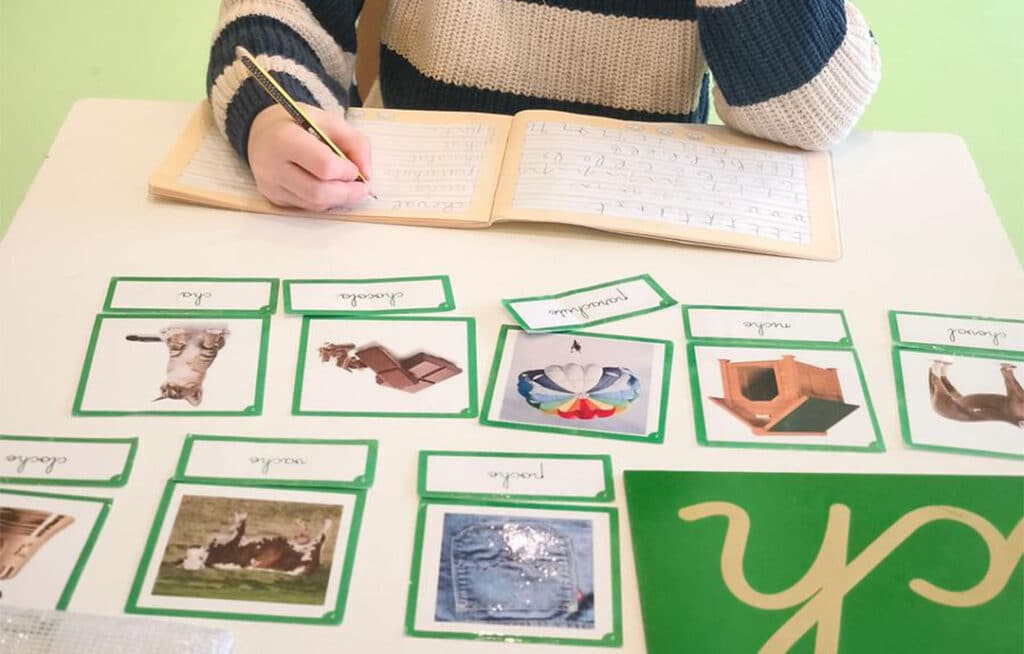
The educator observes before intervening. She demonstrates a gesture by breaking it down, lets the children try, then revisits the mistake without doing it for them. She talks a great deal with them, rephrases, names, explains: the vocabulary built at this age will later nourish understanding. She plays with the sounds of words, links them to letters, to their names and their sounds: reading is already being prepared through brief teaching in a small group.
Showing, doing with the child, then letting them do it alone is the heart of the explicit teaching the educator implements, supported by guided games: she prepares an activity aimed at a specific learning objective, lets the child search, guiding them with a question.
From six to eight: acquire the tools
They follow the line with their finger, stumble over “oi”, guess the end of the word from the picture, and end up saying they are “bad at reading” because the child next to them goes faster.
Learning at this age means making the basic tools automatic. As long as they decode syllable by syllable, they have little attention left for meaning; as long as they count on their fingers, very little for the problem to be solved.
Hook: “Automating means freeing up attention to think”
But an automatic skill without understanding remains fragile, and one can also automate a mistake. First, the rule must be understood, then applied while thinking about it, and finally applied without thinking about it. The child then consolidates this knowledge by using it in context. Automating thus enables them to gain speed and reliability, and this ease strengthens their confidence.
In reading, they discover that “o” and “i” make “oi”, read it slowly, then recognise it at a glance. In arithmetic, they first count on their fingers, discover that 8 + 7 is 8 + 2 + 5, therefore 10 + 5, then know without recounting that it makes 15: it is a number fact, like the times tables.
The educator ensures the rule is understood before having it repeated, through short, regular sessions. She corrects the mistake before it takes hold. When the child guesses, she brings them back to the letters in the word. She varies the exercises and practices so that they also know when to apply each procedure.
To “bad at reading”, she responds by showing them their progress since September.
From nine to eleven: understand, connect, reason
They know how to set up a division, but faced with a word problem, they do not know whether to divide or multiply. They read a text without stumbling over a word, yet miss what it implies. A rule that is only recited is forgotten or applied incorrectly.
At this age, learning means moving from knowledge one applies to knowledge one understands. Knowledge takes on meaning, connects to other situations, and the child begins to explain their reasoning.
Knowledge is truly understood when one knows what it enables one to do and can recognise it in different forms.
If two notebooks cost €6, how much do five cost? If 2 cm on a map represent 5 km, how much do 7 represent?
It is the same problem in different clothing: in both cases, one looks for the value of a single unit—a notebook or a centimetre—then multiplies.
The objects and the numbers have changed, not the structure: that is proportionality. Likewise, knowing the formulas is not enough: one must also know that fencing a garden relates to perimeter, and painting a wall to area.
In reading, this is the role of the implicit. “That evening, Paul set the table without being asked, then emptied the dishwasher. His report card, however, stayed at the bottom of his schoolbag.” Nothing is said, and yet everything is clear: the child must connect two distant clues and attribute to the character an intention he does not state.
The educator places the notebook problem alongside the map problem and asks: “What is the same?” She then has the child draw the problem, and then organises the data in a table: changing form forces understanding. In reading, she asks the child which clues give Paul away. Each time, they must justify their answer. At home, a simple question extends this work: “How do you know?”
Three ages, therefore three ways of learning. Does that mean three pedagogies? No. What changes from one age to another is the share taken by the adult. At three, the educator shows the gesture and does it with the child; at seven, she teaches the tools and has them practise; at ten, she questions them and lets them search.
These stages are not boxes: a nine-year-old still needs gestures, repetition and scaffolding; a four-year-old is already beginning to choose, persevere and do things alone.
At Cube, we therefore do not choose between autonomy and teaching. What cannot be learned alone—such as reading, writing, reasoning or building the first mathematical knowledge—requires an adult to teach it; understanding, however, is what the child constructs. By the end of CM2, we aim for solid knowledge and the habit of working independently.
The goal is not only for the child to know. It is for them to become, little by little, able to learn without us.