
The Montessori method supports children in developing autonomy, confidence, and concentration through a prepared environment, progressive materials (often self-correcting), and the key role of the adult, who observes and guides.
At Cube Education, our schools are inspired by Montessori principles — and some offer accredited Montessori programs and trained teams. Our priority: a demanding yet caring education, aligned with academic expectations.

Each child progresses at their own pace, without pressure or comparison.

The child chooses their activities, self-corrects, and gradually gains confidence in their abilities.

Everything is organized to stimulate curiosity: accessible materials, an orderly and secure atmosphere.

The educator observes, guides, and supports the child, rather than directing or imposing a collective pace.

Interactions take place in an atmosphere of listening, mutual respect, and cooperation.

Manipulating materials allows for a transition from concrete to abstract, fully engaging the senses.

Montessori is an internationally recognized pedagogy, present in many countries. Its strength: simple yet demanding principles — autonomy, concentration, prepared environment — that adapt to various cultural contexts while maintaining the same ambition for the child.
Sources: Global Montessori Census (2022) · Association Montessori de France (AMF).
Montessori materials are designed to meet the child’s needs and nurture their curiosity, in connection with their sensitive periods. Presented individually or in small groups, they invite the child to explore, self-correct, and progress at their own pace — with the attentive support of the educator.
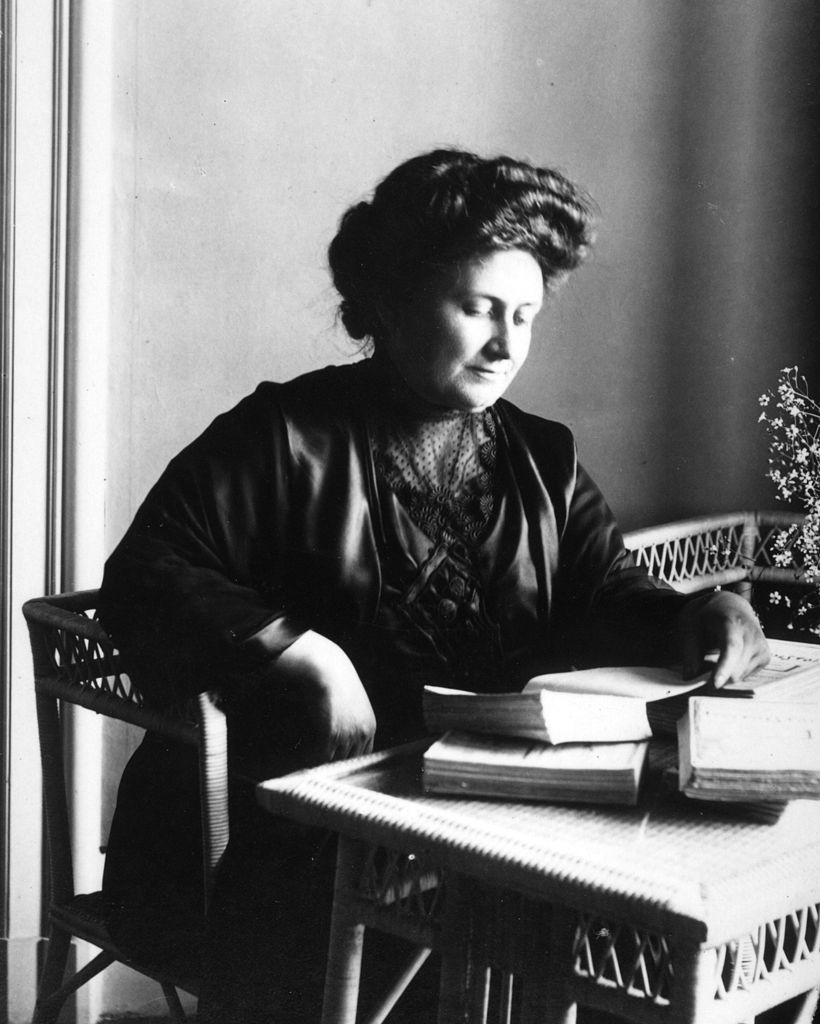
The first woman to graduate in medicine in Italy, Maria Montessori drew on her scientific and psychological knowledge to bring a new perspective on the child. She began her career in a psychiatric clinic, where she observed that so-called “retarded” children lacked motor and sensory activities.
She quickly realized that these young people needed a stimulating environment, adapted materials, and a specific pedagogical approach to progress. In 1907, she created the first “Children’s House” (Casa dei bambini) in Rome, where her method took shape.
Buoyed by her success, Maria Montessori was quickly asked to train teachers and develop her approach. In 1929, she founded the Association Montessori Internationale (AMI) to preserve and disseminate her method worldwide. By her death in 1952, there were already many schools inspired by her pedagogy. Today, there are more than 22,000 Montessori schools on all continents.
Find here the questions families most frequently ask us. To learn more, each school’s profile details its pedagogical framework.
Yes. The objective is to build solid foundations (language, mathematics, culture) while respecting each individual’s pace. Within the Cube Education network, we ensure a demanding yet caring pedagogy, aligned with academic expectations.
Bilingualism is experienced daily: the child enriches their oral language, then reading/writing, with progressive benchmarks. Depending on the school, the FR/EN organization may vary — each institution’s profile specifies the pedagogical framework.