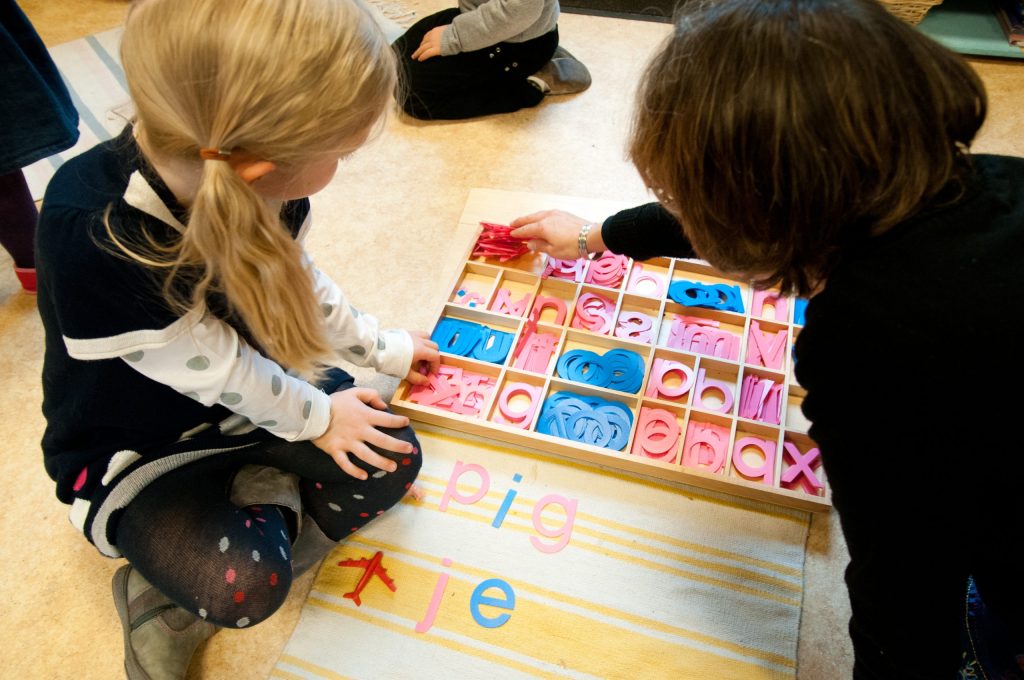
Bilingual education is not just about “doing English”. It relies on regular exposure, in real-life situations, so that the child understands, dares to speak, and then gradually structures their language.
Regular exposure: English is used often, naturally, to create solid foundations.
Real interactions: the child understands, dares to speak, plays, and exchanges — this is where language comes alive.
Continuity: progress is made step by step, with routines and objectives adapted to age.
By getting used to everyday sounds and phrases, children develop benchmarks. They dare to speak more naturally, without fear of making mistakes.
02
Cultural openness
Learning a language also means discovering other ways of telling and understanding the world. Children gain curiosity and listen more to others.
03
Solid foundations
At Cube, bilingualism is based on structured learning, in line with academic expectations. English is integrated into the curriculum, without weakening the fundamentals.
04
Learning to learn
By switching languages, children train their attention, memory, and flexibility. Above all, they progress through regular practice in rich situations.
OUR APPROACH
Bilingualism at Cube Education
Cube Education is a network of private bilingual schools: we offer integrated bilingualism, on a daily basis, with learning in small groups and individualized support — in both English and French.
Our pedagogy remains child-centered, within a demanding and caring framework, in line with academic expectations. Depending on the institution, the organization of bilingualism (time allocation, co-teaching, workshops, projects) may vary: each school’s page specifies its pedagogical and linguistic framework.
Bilingualism is built by living the language every day. Routines, stories, workshops, and projects in English: children understand through action, then dare to speak and progress naturally.
2–3 years: Awakening
Nursery rhymes, pictures, and short games to get used to the sounds of English. Children understand everyday words and follow simple instructions. The goal: enjoyment, listening, and first words, without pressure.
3–6 years: Preschool
Routines, stories, and workshops in English punctuate the day. Children quickly understand “in action”, memorize useful expressions, and gain fluency. Gradually, the language becomes natural in daily life.
6–11 years: Elementary
Oral skills are consolidated and structured: comprehension, vocabulary, reading, and initial grammar concepts. Children express themselves with greater precision.
FAQ
Frequently Asked Questions
Find here the questions families most often ask us. To learn more, each school’s page specifies its pedagogical framework.